PRODUCTS | Avocado Seedlings PRODUCTS | Avocado Seedlings

The avocado tree may be erect, usually to 30 ft (9 m) but sometimes to 60 ft (18 m) or more, with a trunk 12 to 24 in (30-60 cm) in diameter, (greater in very old trees) or it may be short and spreading with branches beginning close to the ground. Almost evergreen, being shed briefly in dry seasons at blooming time, the leaves are alternate, dark-green and glossy on the upper surface, whitish on the underside; variable in shape (lanceolate, elliptic, oval, ovate or obovate), 3 to 16 in (7.5-40 cm) long. Those of the Mexican race are strongly anise-scented. Small, pale-green or yellow-green flowers are borne profusely in racemes near the branch tips. They lack petals but have 2 whorls of 3 perianth lobes, more or less pubescent, and 9 stamens with 2 basal orange nectar glands. The fruit, pear-shaped, often more or less necked, oval, or nearly round, may be 3 to 13 in (7.5-33 cm) long and up to 6 in (15 cm) wide. The skin may be yellow-green, deep-green or very dark-green, reddish-purple, or so dark a purple as to appear almost black, and is sometimes speckled with tiny yellow dots, it may be smooth or pebbled, glossy or dull, thin or leathery and up to 1/4 in (6 mm) thick, pliable or granular and brittle. In some fruits, immediately beneath the skin there is a thin layer of soft, bright-green flesh, but generally the flesh is entirely pale to rich-yellow, buttery and bland or nutlike in flavor. The single seed is oblate, round, conical or ovoid, 2 to 2 1\2 in (5-6.4 cm) long, hard and heavy, ivory in color but enclosed in two brown, thin, papery seedcoats often adhering to the flesh cavity, while the seed slips out readily. Some fruits are seedless because of lack of pollination or other factors.

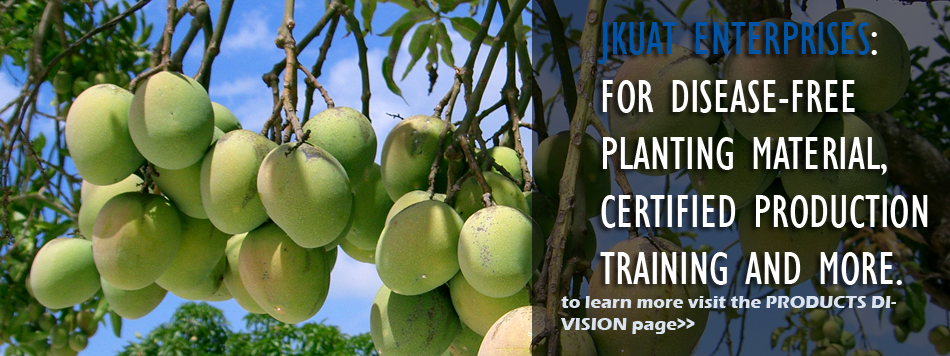
PRODUCTS | Mango seedlings PRODUCTS | Mango seedlings

Mango trees, grown from seeds are known as "seedlings" have a long straight bole. Tree is sympodially branched. Grafted trees on the other hand are dwarf with spreading branches. However, the shape of the canopy also depends on the space available for its development. Isolated trees, getting sufficient space for their growth may differ in tree shape with the same variety grown in the orchard. On shallow soils the growth is stunted. For more information, please see the attachments.

PRODUCTS | Mushrooms PRODUCTS | Mushrooms

Our main organic products are mushrooms which are a known source of the essential nutrient selenium and ergotheioneine - both important antioxidants that help protect the body's cells from damage. Our mushroom line has the following products available:

  • Button Mushrooms - available in 250g punnettes
  • Oyster Mushrooms - available in 250g punnettes
  • Button Mushroom Spawn
  • Oyster Mushroom Spawn

Please note that we also stock dried mushrooms.

PRODUCTS | Passion-fruit Seedlings PRODUCTS | Passion-fruit Seedlings

The passionfruit vine is a shallow-rooted, woody, perennial, climbing by means of tendrils. The alternate, evergreen leaves, deeply 3-lobed when mature, are finely toothed, 3 to 8 in (7.5-20 cm) long, deep-green and glossy above, paler and dull beneath, and, like the young stems and tendrils, tinged with red or purple, especially in the yellow form. A single, fragrant flower, 2 to 3 in (5-7.5 cm) wide, is borne at each node on the new growth. The bloom, clasped by 3 large, green, leaflike bracts, consists of 5 greenish-white sepals, 5 white petals, a fringelike corona of straight, white-tipped rays, rich purple at the base, also 5 stamens with large anthers, the ovary, and triple-branched style forming a prominent central structure. The flower of the yellow is the more showy, with more intense color. The nearly round or ovoid fruit, 1 1/2 to 3 in (4-7.5 cm) wide, has a tough rind, smooth, waxy, ranging in hue from dark-purple with faint, fine white specks, to light-yellow or pumpkin-color. It is 1/8 in (3 mm) thick, adhering to a 1/4 in (6 mm) layer of white pith. Within is a cavity more or less filled with an aromatic mass of double-walled, membranous sacs filled with orange-colored, pulpy juice and as many as 250 small, hard, dark-brown or black, pitted seeds. The flavor is appealing, musky, guava-like, subacid to acid.

PRODUCTS | Pawpaw seedlings PRODUCTS | Pawpaw seedlings

Papaya is a short-lived perennial growing to 30 ft (9.14 m) high. Its hollow, herbaceous stem is usually unbranched. The deeply lobed, palmate leaves are borne on long, hollow petioles emerging from the stem apex. Flowers occur in leaf axils. Older leaves die and fall as the tree grows.
Papaya flowers are fragrant and have five cream-white to yellow-orange petals 1 to 2 in (2.5 to 5.1 cm) long. The stigmatic surfaces are pale green, and the stamens are bright yellow.
Papaya fruits are smooth skinned. They vary widely in size and shape, depending on variety and type of plant. Hermaphrodite plants of commercial 'Solo' varieties in Hawaii usually produce fruits that are pear shaped and weigh approximately 12 to 30 oz (340 to 851 g). Female plants of 'Solo' varieties produce round fruits. Other papaya varieties produce variously shaped fruits, which may weigh up to 20 lb (9.1 kg). The fruits usually contain many seeds surrounded by a smooth yellow to orange-red flesh that is sweet in good varieties.

PRODUCTS | Tissue-Culture Bananas PRODUCTS | Tissue-Culture Bananas

The banana plant, often erroneously referred to as a "tree", is a large herb, with succulent, very juicy stem (properly "pseudostem") which is a cylinder of leaf-petiole sheaths, reaching a height of 20 to 25 ft (6-7.5 m) and arising from a fleshy rhizome or corm. Suckers spring up around the main plant forming a clump or "stool'', the eldest sucker replacing the main plant when it fruits and dies, and this process of succession continues indefinitely. Tender, smooth, oblong or elliptic, fleshy-stalked leaves, numbering 4 or 5 to 15, are arranged spirally. They unfurl, as the plant grows, at the rate of one per week in warm weather, and extend upward and outward, becoming as much as 9 ft (2.75 m) long and 2 ft (60 cm) wide. They may be entirely green, green with maroon splotches, or green on the upperside and red purple beneath. The inflorescence, a transformed growing point, is a terminal spike shooting out from the heart in the tip of the stem. At first, it is a large, long-oval, tapering, purple-clad bud. As it opens, it is seen that the slim, nectar-rich, tubular, toothed, white flowers are clustered in whorled double rows along the floral stalk, each cluster covered by a thick, waxy, hoodlike bract, purple outside, deep-red within. Normally, the bract will lift from the first hand in 3 to 10 days. If the plant is weak, opening may not occur until 10 or 15 days. Female flowers occupy the lower 5 to 15 rows; above them may be some rows of hermaphrodite or neuter flowers; male flowers are borne in the upper rows. In some types the inflorescence remains erect but generally, shortly after opening, it begins to bend downward. In about one day after the opening of the flower clusters, the male flowers and their bracts are shed, leaving most of the upper stalk naked except at the very tip where there usually remains an unopened bud containing the last-formed of the male flowers. However, there are some mutants such as 'Dwarf Cavendish' with persistent male flowers and bracts which wither and remain, filling the space between the fruits and the terminal bud.